
How Our Air Cleaners Work
The Basics
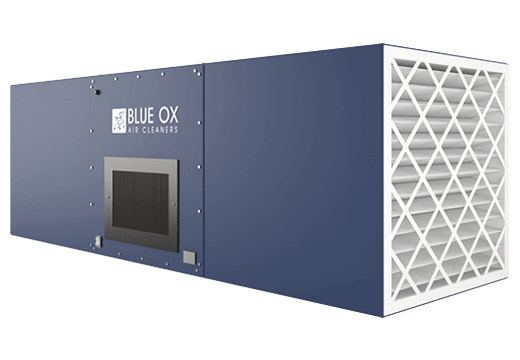
Put simply, a large centrifugal type blower draws the contaminated air from the room through a set of highly efficient micro-glass filters that separate the sub-micron particles from the air stream.
The cleaned air is then discharged back into the room for reuse. No ductwork is required, and there is no loss of heat or air conditioning.
Some units offer charcoal filters for odor control, others offer charcoal banks for heavy odor control.
HEPA units are available for applications that demand the ultimate in clean air. Making our air cleaners versatile for many different applications.
Configurations (T vs. Pass-thru)
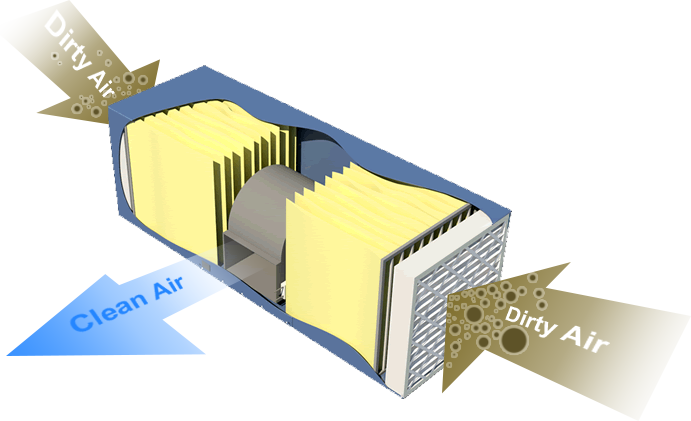
T-Style
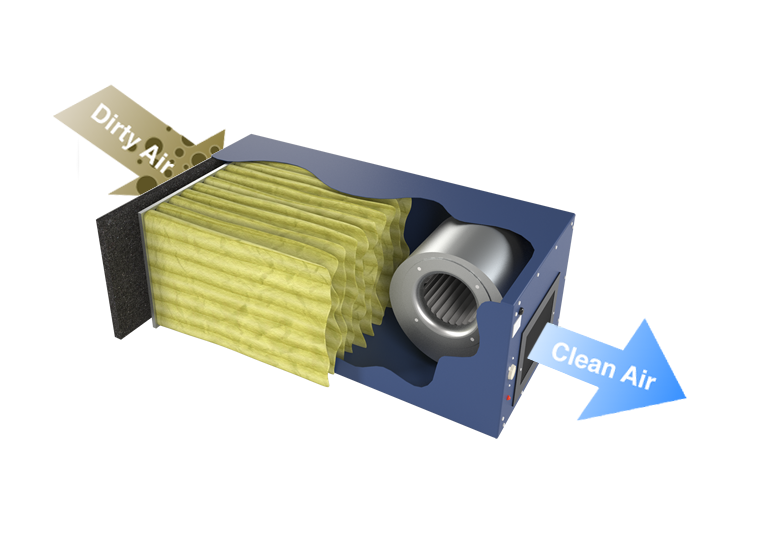
Pass Through
Our air cleaners are available in two different configurations: pass-thru and T style
• The pass-thru style has the grill/fan on one end and filters on the other end.
Air filtration systems featuring this style pull the dirty air through the filters and exhausts it through the grill on the other end, creating a straight-flow motion.
• The T style configuration has the grill/fan placed in the center and draws the dirty air through filters on both sides, exhausting it from the center of the unit.
With this configuration, you get double the media in a unit than the pass-thru style.
Planning / Placement
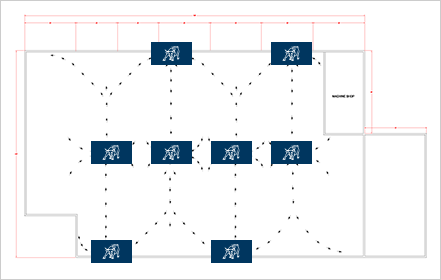
Air cleaners work best when used in tandem. By placing the air filtration systems in a pattern where they create a circular air flow pattern, they can clean the same air multiple times.
Each air cleaner has a specific "catch" and "throw" distance which determines how far apart they can be placed in order to ensure that the air will continue to move from one unit to the next.
By utilizing the corners of a room, you can create this circular pattern necessary to optimally clean the air.
The number of times that the air is circulated through this pattern is referred to as an "air exchange".
Depending upon your application, you may require more or fewer exchanges in order to properly clean the air.
Please feel free to consult our experts for proper planning/placement.


Copyright © 2024 | Blue Ox Air Cleaners. A division of Air Cleaning Specialists, Inc.